
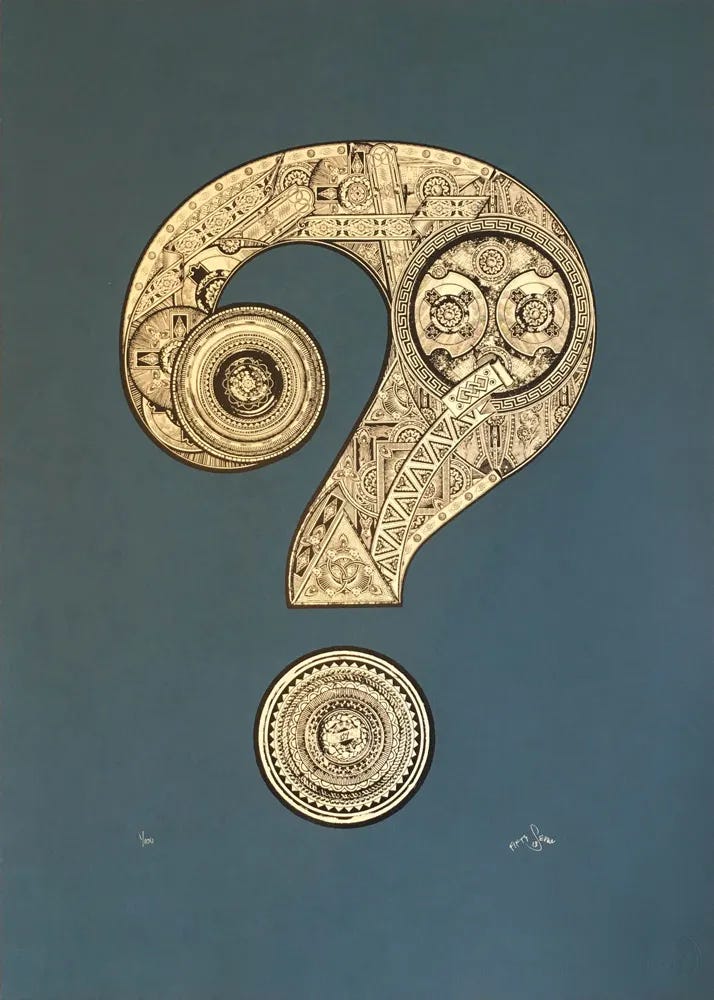
Perhaps the most vexatious of all the puzzles which philosophers have pondered throughout the ages is that of the meaning of life, of what we ought to do with this magical gift, of how we ought to act and what we ought to care about, if we wish to live well. This was the original aim of all philosophy, a fact which has been largely forgotten in the academic echo-chamber of modernity: one ponders the orb as means to an end, as a way to discover the good life. Yet there is so much that man does not know, that it seems he must endeavour first to alleviate his ignorance if he is to have any hope of attaining a definitive solution to this problem.
This is the approach of the philosopher: he wants to analyze the problem, cutting it up into bite-sized pieces and digesting them one by one until he poops out an answer which consists mainly of the bits he didn’t manage to understand. This isn’t an attempt to bash philosophy — man has produced some magnificent turds in his time, and some philosophers love to play in their filth, polishing it up and using it to paint systematic apologia about poop-painting on the walls of their houses.
Maybe the everyday man has a better idea? If we ask him he always gives the same answer, absolutely rudimentary and yet charming in its simplicity; he says the meaning of life is simply to live, to experience and to appreciate and to enjoy the time you have on this earth with the people around you. It cannot be denied that there is a measure of truth in this, and no small one at that, however this seems to leave unexpressed so many of the questions which cry out for an answer. How are we to live? What are we to do? Who ought we to love? What even is love? Why does life involve so much pain? What is the meaning of all this?
So many questions — where is one to begin? If the meaning of life is to live, then the least we could do, it seems, is to observe how we live, and to contemplate the meaning of what it is that we do, since the meaning is apparently in what we do. So, what is it that creatures like us do with our time? Many things, of course, but one more than all the others: we ask questions and seek answers. Man has been defined in many ways: homo sapiens means twice-wise ape, while humanity of course means compassion — perhaps an aspiration more than a description. Man has been called He Who Watches and He Who Knows, but he is at his core a questioning being.
But… what is the question to which we ought to attend?
With a near infinity of options, and a limited amount of time, we are put in a unique situation: we must figure out what questions are most important to us, which itself involves us in a series of questions about who we are and what matters to us as individuals. In order to discover this information, we are well served by having lived, and here the charm of the simple answer blossoms into merit, for one cannot reflect upon their identity unless they have memories which they already treasure and despise. Yet it cannot be denied that simply living out these events is not enough for creatures such as we: we seek to understand, we strive to know. It was in this spirit that Plato had Socrates say “the unexamined life is not worth living” — but he was wrong.
The unexamined life is surely worth living; it is perhaps even more worthy of precisely that, living, than the examined life, however it cannot be denied that, without examination, one can scarcely appreciate what it is that one lives. One has only the immediacy of the experience, and the attendant impressions; entirely absent is the reflective weighing of experiences which results in a hierarchical organization of values, inevitably leading to a vague and trepidatious approach to a concept of the highest value. Only via this pass through the mountains can one attain the good life; all other ways are blocked.
On one hand, it is perfectly true and proper that the meaning of life is simply to live, for what else does life consist in but this? Life is far more about showing up than it is about your abstractions about what goes on. In addition, one can hardly examine the meaning of life if one has not yet lived — one must have something of substance to examine, and ideally that object of inquiry ought to be richly detailed, both deep and broad, and touched by a human understanding that transcends mere intellection. In this nothing could be more useful than to experience this wide world of ours, to immerse oneself in the moment and follow the instinctive sense one has of what is important, what matters, what is worthy of attention.
On the other hand we have the simple fact that the meaning of life cannot truly be found in any activity except meditating upon that very question: the meaning of life. After all, we are not just living beings, but we are born into self-consciousness by the long tradition our species has upheld surrounding the practice of question and answer. Just as the meaning of life goes beyond mere living, encompassing the imperative to meditate upon the mystery of one’s life in search of that meaning, so too the answer to the most fundamental question of all is exactly that same question:
What is the question?
One thing about my life that I examined recently is that I want to try to do hobbies more. Having something to look forward to makes life more meaningful. It also seems to make work more meaningful as well, because I have something to look forward to afterwards. Not only that, but also I find that my philosophy about work matters to. I think that I am benefitting people when I work, which is what I try to focus on.
Excellent. Did you ever read my “Notorious and Nonsensical “Y” article? Be curious your thoughts.